Our Story
We started with one question: who actually grew this honey?
Five years later, we have 125 answers — each with a name, a village, and a story. This is how we got here.
In Brief
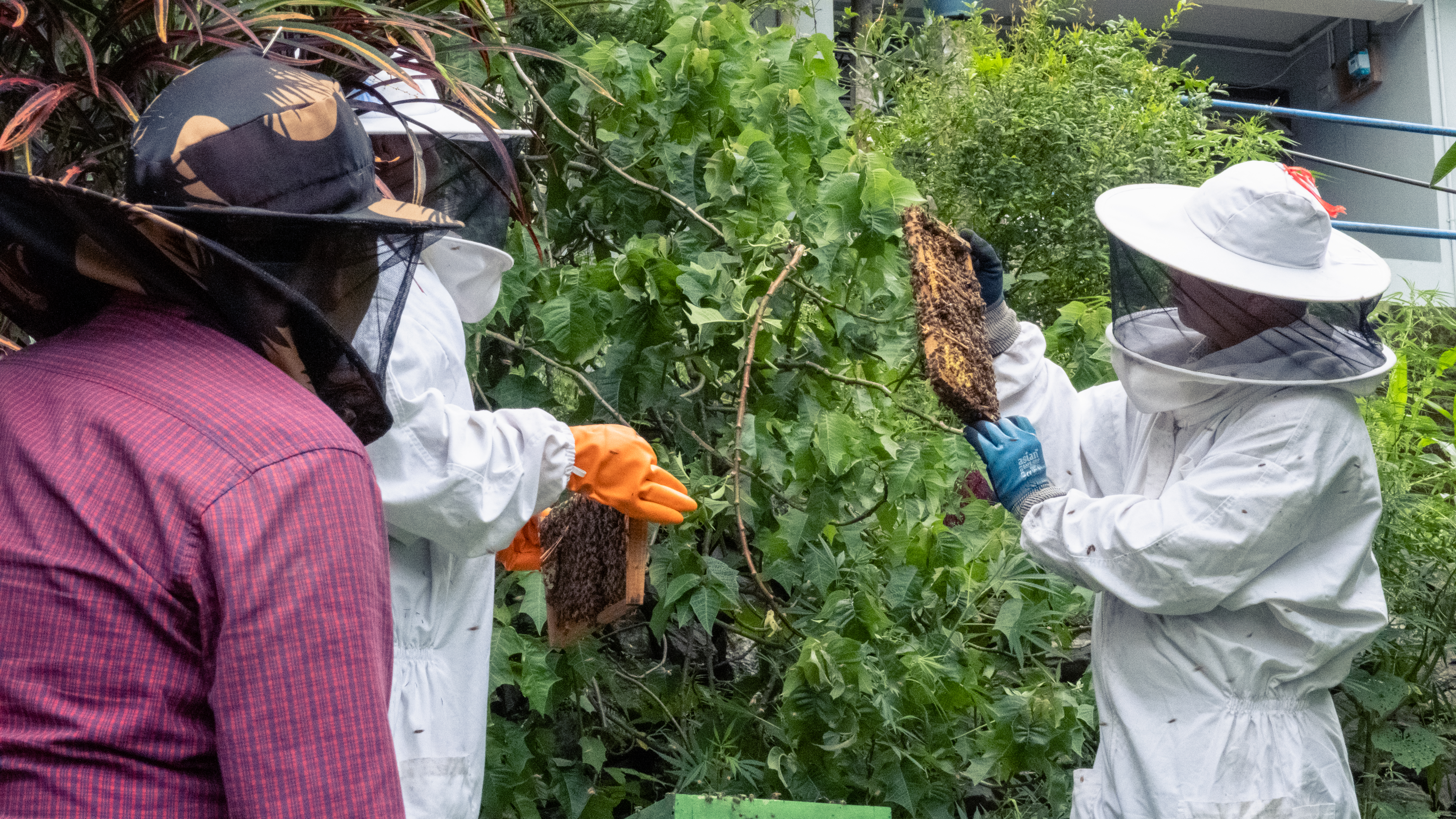
ApiCare is a smallholder honey collective from Sikkim, the small Himalayan state in northeast India that became, in 2016, the first place on earth to declare itself fully organic. We started in 2020 with twelve beekeepers in one village. Today we work with one hundred and twenty-five.
125
Verified beekeepers
4
Districts of Sikkim
2016
Sikkim went fully organic
3–4×
Above local market price
Chapter One
01
The valley
Sikkim runs from sub-tropical river valleys at 700 metres up to alpine pasture above 6,000. In the space of a single day's drive you pass through five distinct forest belts — broadleaf, conifer, rhododendron, alpine, and snowline — and the species count rises with every kilometre. The state is roughly the size of Luxembourg and contains close to a third of the flowering plants found in all of India.
For bees, this is a kind of paradise. The forage is uncontaminated — no chemical fertilizer, no pesticide, no industrial agriculture anywhere in the state. The biodiversity gives the bees a long, layered flowering season. And because the terrain is steep and the villages are small, the forest cover has stayed largely intact in a way that almost nowhere else in mainland India has managed.
Sikkim's organic status is sometimes treated, in the wider Indian conversation, as a kind of well-meaning eccentricity. We don't see it that way. From where we sit, on the edge of the forest with the hives, it looks like the most quietly radical agricultural decision any state has made in this century.
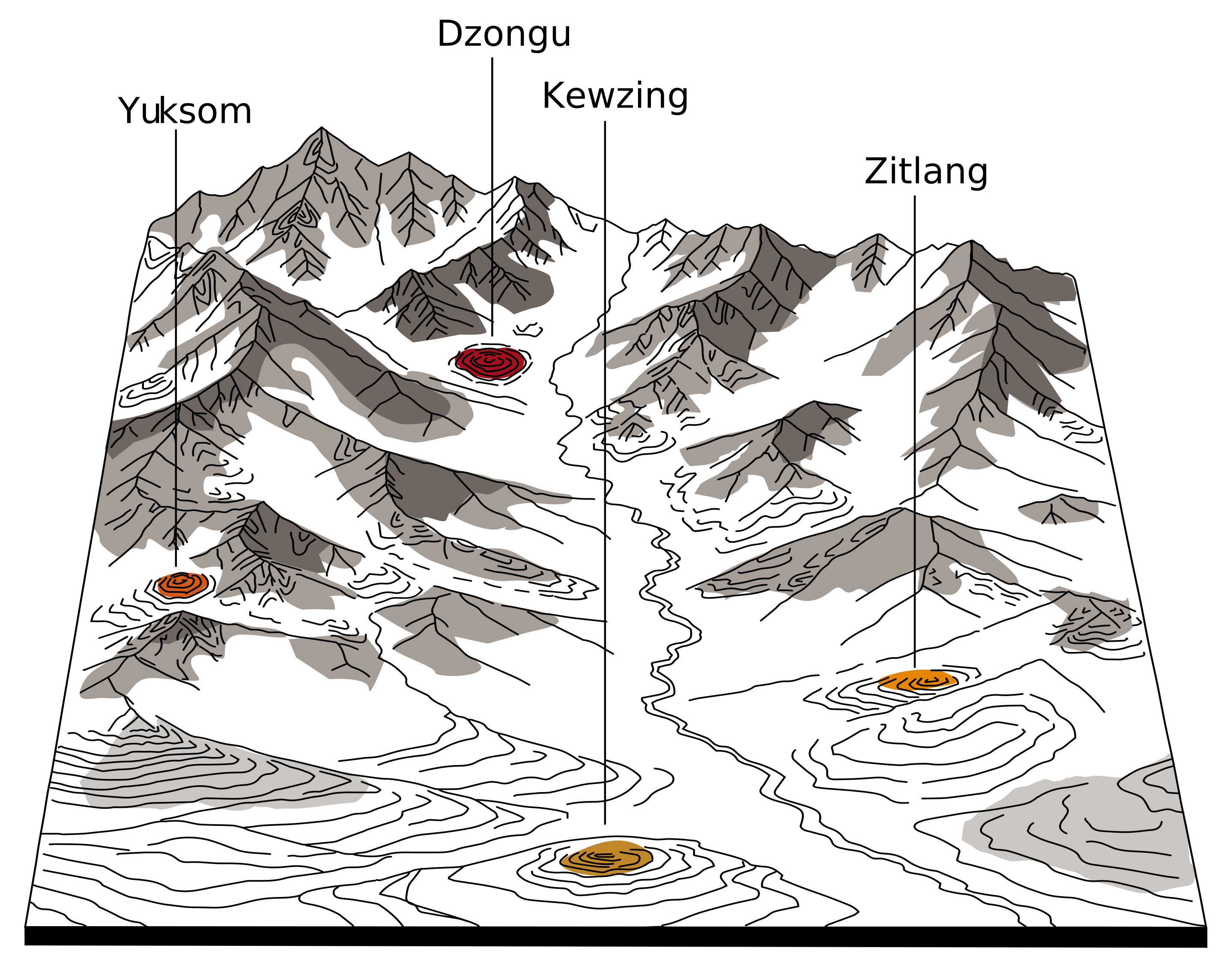
Four districts.
Four source villages.
Chapter Two
02
The problem
Smallholder beekeepers, in Sikkim and across most of South Asia, have been invisible to the global honey market for decades. Their honey moves through middlemen who blend it with cheaper sources, strip out the origin information, and sell it on at a margin the beekeeper never sees. By the time a jar reaches a supermarket shelf, the only person who has not been paid fairly is the person who actually kept the bees.
For the beekeeper, the math is brutal. A typical Sikkim smallholder, working with eight to twelve hives, was earning between ₹300 and ₹500 per kilogram of honey when we first started visiting villages in 2020. International specialty markets were paying ten to fifteen times that — for honey that was, in many cases, less distinctive than what was sitting in the smallholder's storage drum.
The information asymmetry was almost total. The beekeeper didn't know what their honey was worth. The buyer abroad didn't know who had grown it. The middleman, who knew both, was the only party who could capture the difference.
The beekeeper didn't know what their honey was worth. The middleman did.
10–15×
The gap between what international specialty markets paid for premium single-origin honey and what Sikkim smallholders received from local middlemen in 2020.
Chapter Three
03
How ApiCare started
We registered ApiCare Organic Farms in 2020, in the middle of the pandemic, with a single hypothesis: if you could verify exactly who produced each jar of honey, and prove it to the buyer, the middleman becomes optional. The beekeeper sells direct. The buyer sees the source. The price meets where it should — somewhere between what the beekeeper deserves and what the market will pay for genuine single-origin honey.
The first year was small and slow. Four villages, twelve beekeepers, a lot of conversations on plastic chairs in front of houses. The collective grew when the Government of Sikkim's RAMP programme — a state-level initiative to professionalise rural agribusinesses — recognised us as a partner in 2022. That gave us a formal framework, training infrastructure, and a way to scale beyond the founders' own contacts.
Today we work with 125 verified beekeepers across all four districts of Sikkim. Every beekeeper is named. Every harvest is logged. Every jar carries a code that traces back to the village it came from.
Timeline
- 2020 Founded — twelve beekeepers, one village
- 2021 First Master Trainer program in Zitlang
- 2024 Recognised by Government of Sikkim — Commerce & Industries Department
- 2025 Dzongu conversations begin
- 2026 EU export pipeline
Chapter Four
04
What we are building next
Two things, on parallel tracks.
The first is the EU export pipeline. Sikkim honey has the agroecological credentials to compete with the best European wild-forest honey — but Indian smallholder honey has historically been blocked at the EU border by chain-of-custody requirements that no traditional supply chain can meet. We are working through Eurofins testing and EU organic certification now, and we expect to be shipping into European specialty channels within the next eighteen months.
The second is FarmLedger, our digital traceability system. Right now it powers the QR codes on our jars. Eventually we want it to power traceability for any smallholder agricultural product, anywhere — coffee, cardamom, cacao, vanilla. The underlying argument is the same in all of these categories: the producer is invisible, the buyer is willing to pay for visibility, and the only thing missing is the proof system in the middle.
ApiCare is the first proof. The honey is what people taste; the system behind the honey is what we are actually building.
— The ApiCare team, Sikkim
Two parallel tracks
Track One
EU export pipeline
Eurofins testing, EU organic certification, specialty channel partners. ETA: eighteen months.
Track Two
FarmLedger
Digital traceability infrastructure for smallholder agriculture. Honey first, then coffee, cardamom, cacao.